
Excel filter option cannot be found


Working in a large data set in Excel but filter option cannot be seen or found even clicking the sort and filter option multiple times, the drop-down filtering options is nowhere to be found.

Well, just get back to the very basic steps. If it can’t be seen then it might be hidden, right?

So, when working in a large data set but some other rows is not needed and need to be hidden. Just leave the first row visible and do not hide it, then hide other rows.

The drop down filter option is in row 1, so if it is hidden then of course the drop down filter will also go with it.

To unhide row 1 or cell a1, press Ctrl + G. The go to options  window will pop-up, type: A1 to go to cell A1. (see pic below)


Then, press ctrl+shift+9 to unhide the row. Or click on the format menu options and select unhide. (see pic below for excel 2016). Then the filter option will be displayed.
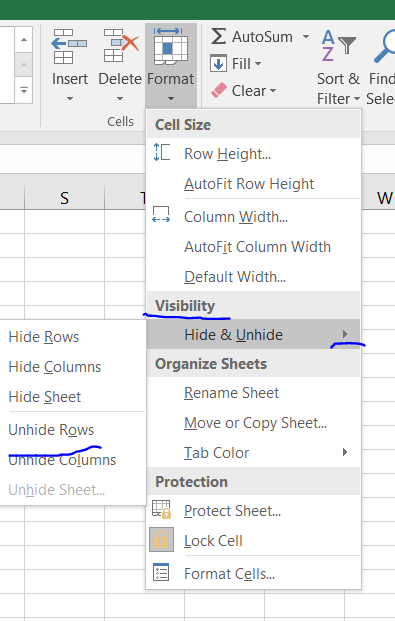


The keyboard shortcut I think will work on other versions of Excel.

If you need the filter option in Excel, row 1 must never be hidden or else it might take a few minutes or hours to realize a silly mistake.


Till next time. Cheers~!


================================
Free Android Apps:

Click  links below to find out more:

Linux Android App cheat sheet:

Heaven's Dew Fall  Prayer app for Android :


Catholic Rosary Guide  for Android:


Divine Mercy Chaplet Guide (A Powerful prayer):

Comments

Popular posts from this blog

Print error 016-799 - Fuji Film Xerox

016-799 Fuji Xerox or Fuji Film print error code. That shows a description error as “Print instruction Fail detected in decomposer.” The error code and error description are alien languages for users and even system administrators who are not familiar with Fuji Xerox error code. The error code is quite simple and easy to fix, if the job print goes to the printer but print out doesn’t come out. So, basically the print job was received by the printer, but the printer just doesn’t know what type of paper or what size to use or which tray to utilize for the print out. In some instances, this is just a paper mismatch but the error description; if using Windows 10 to print does not exactly points to what is the issue. First thing to check, is the paper size selected by the user to print. Example, if the printer configuration is A3 and A4 sizes only. But then the person printing the file accidentally chooses “A4 Cover” then this error 016-799 will occur. ...

WMIC get computer name

WMIC get computer model, manufacturer, computer name and  username. WMIC is a command-line tool and that can generate information about computer model, its manufacturer, its username and other informations depending on the parameters provided. Why would you need a command line tool if there’s a GUI to check? If you have 20 or 100 computers, or even more. It’s quite a big task just checking the GUI to check the computer model and username. If you have remote computers, you need to delegate someone in the remote office or location to check. Or you can just write a batch file or script to automate the task. Here’s the code below on how get computer model, manufacturer and the username. Open an elevated command prompt and type:     wmic computersystem get "Model","Manufacturer", "Name", "UserName" Just copy and paste the code above, the word “computersystem” does not need to be change to a computer name. A...

Delete Directories with Wildcards using rd or rmdir

  Deleting files in command prompt using wildcards is quite straight forward. Command below will delete all text (".txt") files on the specified path.      Del D:\txtlog\*.txt Command above will delete all files with ".txt" extension in d:\txtlog directory. Easy enough to delete all matching files. Using the same method with rmdir or rd command this will not work. For example, if we have a directory on d drive that is auto-generated by an application and the filename is consistent with a pattern plus incrementing number at the end to differentiate the folder from other folders.    D:\baklogs\log1\    D:\baklogs\log2\    D:\baklogs\log3\    Etc..    D:\baklogs\log100\ The folder name has a consistent pattern that is preceded by the word “log” plus incrementing number. If the command below is executed to remove the directories in one go, an error is shown which h...